Brennschneiden
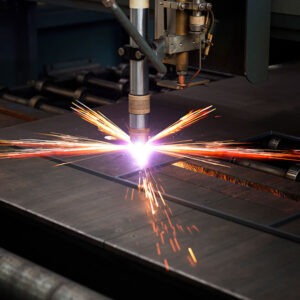 Autogenes Brennschneiden (auch Autogenschneiden oder Brennschneiden genannt) ist eine recht beliebte Variante des thermischen Schneidens, die in der Industrie eingesetzt wird. Es gibt mehrere verschiedene Gasarten, die für dieses Verfahren verwendet werden können, wobei die Endergebnisse deutlich variieren.
Einer der Hauptgründe für die Beliebtheit dieses Verfahrens ist die Bandbreite der Materialien, die damit geschnitten werden können – die Materialstärke, die mit dem Brennschneiden bearbeitet werden kann, reicht von 0,5 mm bis 250 mm. Die Ausrüstungskosten für das Brennschneiden sind im Branchenvergleich ebenfalls relativ günstig, und der gesamte Prozess kann maschinell und nicht nur manuell durchgeführt werden.
Der Prozess des Brennschneidens
Im Grunde genommen ist das Brennschneidverfahren relativ einfach – in seiner einfachsten Form ist eine Brennschneidmaschine eine Düse, die sowohl den primären Sauerstoffstrom als auch mehrere sekundäre Ströme der Kombination aus Sauerstoff und Gas, die als Brennstoff dient, leitet.
Das betreffende Metallstück wird zunächst mit der Kombination aus Gas und Sauerstoff vorgewärmt (auf etwa 700-900 Grad Celsius, eine so genannte “Zündtemperatur”). In diesem Zustand ist das Metallstück nicht heiß genug, um zu schmelzen, aber immer noch heiß genug, um den Schneidprozess durchführen zu können.
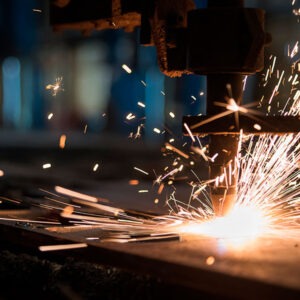
Nach dem Erhitzen des fraglichen Metallstücks leitet die Primärdüse einen Sauerstoffstrom auf das erhitzte Stück, wodurch eine chemische Reaktion zwischen dem Metallstück und dem Sauerstoff ausgelöst wird. Bei dieser Reaktion entsteht eine “Schlacke”, d. h. Eisenoxid, das sofort durch denselben Sauerstoffstrom weggeblasen wird, der die Reaktion ausgelöst hat, so dass die Düse selbst mit dem Schneiden des Metallstücks fortfahren kann.
Das Brennschneiden als Ganzes hat vier Hauptvoraussetzungen, um überhaupt durchgeführt werden zu können:
- Der Grad der Sauerstoffverdünnung sollte so gering wie möglich sein, da er sich negativ auf die Leistung des gesamten Schneidprozesses auswirken kann.
- Wie wir bereits erwähnt haben, muss die Temperatur des Metallstücks unter dem Schmelzpunkt liegen, damit der Schneidprozess wie geplant ablaufen kann.
- Der Umfang der Oxidationsreaktion zwischen dem Metall und dem Sauerstoff muss groß genug sein, damit die Zündtemperatur auf demselben Niveau bleibt.
- Der Schmelzpunkt des entstehenden Oxids muss unter der aktuellen Temperatur des Metalls liegen, sonst würde die “Schlacke” nicht durch den Sauerstoffstrom weggeblasen werden.
Es ist wichtig zu erwähnen, dass verschiedene Materialien (Edelstahl, verschiedene Nichteisenmetalle, Gusseisen usw.) unterschiedliche Oxidschmelzniveaus haben, was die Zugabe von Pulver erforderlich macht, um die Oxidschmelztemperatur zu senken und eine “Schlacke” zu erzeugen, die weggeblasen werden kann.
Verschiedene Gasarten
Es sollte keine große Überraschung sein, dass beim Brennschneiden verschiedene Gasvarianten für die Durchführung von Brennschneidprozessen verwendet werden können. Es gibt drei Hauptmerkmale, anhand derer sich ein bestimmter Brenngastyp unterscheiden lässt:
- Die Gasmenge, die für den Beginn des Verbrennungsprozesses benötigt wird;
- Die höchstmögliche Flammentemperatur – normalerweise an der Spitze des Innenkegels;
- Die erzeugte Wärme des verbrannten Gases.
Es gibt fünf Hauptgasarten, die regelmäßig für Brennschneidverfahren verwendet werden: Erdgas, MAPP, Acetylen, Propylen und Propan. Wir können auf jede einzelne von ihnen etwas ausführlicher eingehen.
Erdgas
Eine Gasart, die von allen fünf hier genannten die geringste Leistung aufweist, ist Erdgas. Seine Wärmeverteilung liegt bei 1.490 kj/m^3, was mindestens zehnmal weniger ist als bei drei der vier übrigen Gasarten. Es hat die langsamste Anzündgeschwindigkeit und die niedrigste Flammenspitzentemperatur (2.770 Grad Celsius) und ein nicht gerade geringes Verhältnis zwischen Brenngas und Sauerstoff – 1,8 zu 1.
MAPP (Methylacetylen-Propadien)
MAPP ist eine Kombination aus Propadien, Methylacetylen und einigen anderen Kohlenwasserstoffen. Seine Leistung ist insgesamt recht durchschnittlich, mit einer Flammenspitzentemperatur von 2.976 Grad Celsius und einer relativ hohen Wärmeabgabe sowohl für die Primär- als auch für die Sekundärflamme (15.445 kj/m^3 bzw. 56.431 kj/m^3). Diese Kombination von Parametern macht es zu einer relativ durchschnittlichen Gasart in Bezug auf die Schneidgeschwindigkeit, aber es kann bei höheren Druckwerten verwendet werden, was es zu einer guten Wahl für verschiedene Unterwasserschneidverfahren macht.
Acetylen
Wenn wir nach einer Gasart mit der höchsten Flammentemperatur (3.160 Grad Celsius) suchen, dann ist Acetylen die richtige Wahl. Natürlich macht die höchste Spitzentemperatur Acetylen zu der Gasart mit einer der schnellsten Schneidgeschwindigkeiten von allen. Seine Flamme ist auch viel schneller als die von Propan, und sie konzentriert sich hauptsächlich auf den inneren Kegel, wodurch die Gesamtfläche des Metalls, auf die die Hitze einwirkt, und damit auch der Prozentsatz der Verformung insgesamt reduziert wird.
Propylen
Eine weitere interessante Variante einer Gasart ist Propylen, ein flüssiges Erdölgas. Es bietet eine eher durchschnittliche Flammenspitzentemperatur (etwa die gleiche wie MAPP – 2896 Grad Celsius), kann dies aber durch eine hohe Wärmeabgabe im äußeren Kegel ausgleichen – etwa 72.000 kj/m^3. Gleichzeitig hat es den großen Nachteil, dass es ein hohes Brenngasvolumen benötigt – das Verhältnis von Sauerstoff zu Brenngas beträgt 3,7 zu 1.
Propan
Propan ist die letzte der fünf Gasarten, die eine eher niedrige Spitzenhitze erzeugt, aber einen größeren Wirkungsbereich für die Hitze um die Düse herum bietet. Durch die allgemeine Beschaffenheit von Propan ist die Schneidflamme im Vergleich zu Acetylen etwas breiter, aber die Gesamtschneidgeschwindigkeit ist mit der von Acetylen vergleichbar – auch wenn die Einstechgeschwindigkeit aufgrund der geringeren Spitzenhitze (2.828 Grad Celsius) langsamer ist.
Gasschneiden im Levstal
Das Brennschneiden ist ein recht vielseitiges Verfahren, das mit verschiedenen Gasarten und Düsenanordnungen unterschiedliche Schneidvarianten für verschiedene Anwendungsfälle bietet. Die Spezialisten von Levstal verwenden zwei ESAB SXE-P1 4500 Maschinen für das Sauerstoffstrahlschneiden (Brennschneiden) und sind in der Lage, Schwarzbleche mit folgenden Parametern zu bearbeiten: Dicke 15 – 150 mm, Breite bis zu 2800 mm, Schnittlänge bis zu 18000 mm.
Gas Cutting
Oxyfuel gas cutting (also referred to as oxyfuel cutting or gas cutting) is a rather popular variation of thermal cutting process applied at industrial level. There are several different variations of gas that can be used to perform this process, with a noticeable variation of the end results.
One of the biggest reasons for why it is so popular is the range of materials that it can cut – the material thickness that gas cutting can work with ranges from 0.5mm to 250mm. The equipment costs for gas cutting are also relatively cheap by industry standards, and the entire process can be performed mechanically, and not just manually.
The process of gas cutting
Fundamentally speaking, the gas cutting process is relatively simple – in its most basic form, a gas cutting machinery is a nozzle that directs both the primary oxygen stream, as well as several secondary streams of the combination of oxygen and gas that serves as a fuel.
The metal piece in question gets preheated first using the combination of gas and oxygen (to about 700-900 degrees Celsius, a so-called “ignition” temperature). In this state, the metal piece is not hot enough to melt, but still hot enough for the cutting process to be conducted.
After heating up the metal piece in question, the primary nozzle directs a stream of oxygen to the heated piece, instigating a chemical reaction between the metal piece and the oxygen. This reaction creates a “slag”, or iron oxide, that immediately gets blown away by the same oxygen stream that initiated the reaction, allowing for the nozzle itself to proceed with cutting the metal piece.
Gas cutting as a whole has four main prerequisites to be conducted in the first place:
- The level of oxygen dilution should be as little as possible, since it can negatively impact the performance of the cutting process as a whole.
- As we’ve mentioned before, the metal piece’s temperature must be below melting point for the cutting process to proceed as planned.
- The scope of oxidation reaction between the metal and the oxygen must be large enough for the ignition temperature to stay at the same level.
- The melting point of the created oxide must be lower than the current temperature of the metal, or the “slag” would not be blown away by the oxygen stream.
It’s important to mention that different materials (stainless steel, various non-ferrous metals, cast iron, etc.) have different oxide melting levels, which creates a requirement of adding powder to lower the oxide melting temperature and to create a “slag” that can be blown away.
Different gas types
It should not be a big surprise that gas cutting can use different gas variants to perform gas cutting processes. There are three main characteristics that can be used to distinguish some specific fuel gas type:
- The volume of gas that is needed for the combustion process to begin;
- The highest possible flame temperature – usually at the tip of the inner cone;
- The produced heat of the combusted gas.
There are five main types of gas that are regularly used to perform gas cutting processes – natural gas, MAPP, acetylene, propylene and propane. We can go over each and every one of them in a bit more detail.
Natural gas
One gas type that has the lowest performance out of all five here is natural gas. Its heat distribution levels are at 1,490 kj/m^3, which is at least ten times less than three of the four remaining gas types. It has the slowest piercing speed and the lowest peak flame temperature (2,770 degrees Celsius), and not that low of a ratio between fuel gas and oxygen – 1.8 to 1.
MAPP (Methylacetylene-propadiene)
As the gas type goes, MAPP is a combination of propadiene, methylacetylene, as well as some other hydrocarbons. Its performance is quite average as a whole, with 2,976 degrees Celsius peak flame temperature and relatively high heat release levels for both primary and secondary flames (15,445 kj/m^3 and 56,431 kj/m^3, respectively). This combination of parameters makes it a relatively average gas type in terms of cutting speed, but it can be used at higher pressure levels, which makes it a great choice for various underwater cutting procedures.
Acetylene
If we’re looking for a gas type with the highest flame temperature (3,160 degrees Celsius), acetylene is the one we’re looking for. Of course, the highest peak temperature makes acetylene the gas type with one of the fastest cutting speeds out of all of them. Its flame is also way faster than something like propane, and it is mostly focused on the inner cone, reducing the overall area of the metal that is affected by heat, and thus reducing the distortion percentage as a whole.
Propylene
Another interesting variation of a gas type is propylene, which is a liquid petroleum gas. It offers a rather average peak flame temperature (about the same as MAPP – 2896 degrees Celsius), but can compensate with a high level of heat release in the outer cone – about 72,000 kj/m^3. At the same time, it also has a rather big disadvantage of having a high fuel gas volume requirement – 3.7 to 1 oxygen to fuel gas ratio.
Propane
Propane is the last gas type out of five, producing a rather low peak heat level, but offering a higher area of effect for the heat around the nozzle. While the overall propane nature makes the cutting flame a bit more spread-out when compared with something like acetylene, the overall cutting speed is on par with said acetylene – even if the piercing speed is slower, as a consequence of lower peak heat level (2,828 degrees Celsius).
Conclusion
Gas cutting is quite a versatile process that has several different gas types and nozzle arrays, offering different variations of cutting for various use cases. Levstal specialists use two ESAB SXE-P1 4500 machines for oxygen jet cutting (gas cutting), and are capable of working with black sheet metal with the following parameters: thickness 15 – 150 mm, width up to 2800 mm, cut length up to 18000 mm.


